
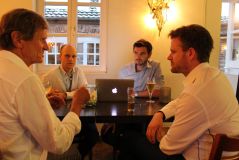
Can psychological research still be trusted? In-Mind interviewed Daniel Lakens and Klaus Fiedler-two of the most prominent voices in the debate on how psychological science can be improved. In this interview, they offer a personal view on how psychology has changed and how it should change in the...
Authored on

The two previous “Solid Science” posts for this blog have covered important changes taking place in experimental psychology. If you have not read them, I recommend you do. In this post I report on another, larger change occurring in the field: the replication movement.
Authored on

You can still make a joke, right? Yes, but... misogynistic jokes about women can have negative consequences. What can such humor do to women and men?
Authored on

In this blog post, I will report on the experiences of social psychologists, such as myself, with committing ourselves to detailed descriptions of the hypotheses and other specifics of experiments before we run them. In part 1, I briefly cover some basics about this so-called pre-registration and...
Authored on

Reproducibility is seen as the gold standard for solid science. However, three are few incentive to work transparently, and even less incentives to conduct replication studies. To change this, more and more teachers are assigning replication studies to graduate students as a class assignment. Will...
Authored on
Where do all the studies come from? Behind every headline trumpeting a new finding in psychology, you can usually find an article in a peer-reviewed psychology journal. But how reliable are these findings? This is what many scientists have recently started to wonder. Because of this, journals in...
Authored on

With the recent news regarding the questionable nature of the infamous Stanford Prison Experiment, we thought it was purdent to republish one of our earlier blog articles drawing attention to the issue. The piece below appeared on our blog in 2012. A blogpost by the Neurocritic suggests that the...
Authored on
Are fraud and other questionable practices in science caused by a few bad apples, or a culture that rewards based on results, not rigor? In this post, I will argue that our scientific environment is selecting for the wrong kind of scientist.
Authored on